
Transactions
Brand valuation in support of a cross-border equity discussion
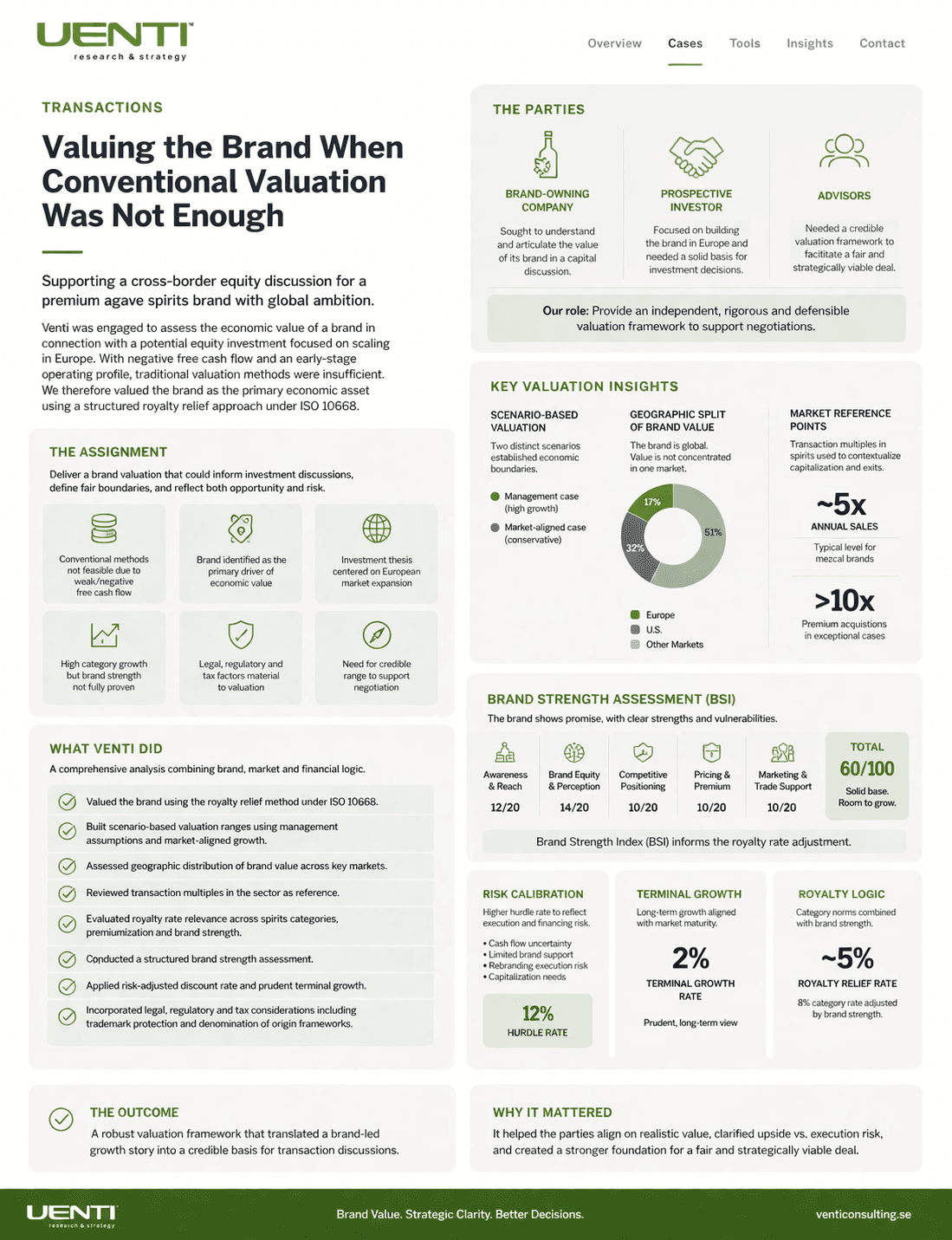
Venti was engaged in connection with a potential equity investment involving a premium agave spirits brand and a prospective investor focused on building the brand's position in Europe. The work sat at the intersection of brand economics, transaction strategy, and international expansion.
The assignment
The work needed to support three sides of the discussion: the brand-owning business, the prospective investor, and the advisory need for a valuation framework credible enough to support a fair and strategically viable equity discussion.
Why a standard model was not enough
A conventional earnings-based valuation was too weak on its own because the business was not generating the kind of stable free cash flow that would normally support a standard discounted cash flow approach. The analysis therefore focused on the brand as the central intangible asset and applied the royalty relief method under ISO 10668 logic.
What Venti did
The valuation was built as a structured transaction framework rather than a single abstract number.
- valued the brand using the royalty relief method under ISO 10668 logic
- built scenario-based valuation ranges using both management assumptions and market-aligned growth assumptions
- assessed geographic distribution of brand value across key markets
- reviewed transaction multiples in the sector as a reference point for capitalization and potential exit logic
- evaluated royalty rate relevance based on category norms, premium positioning, and brand strength
- conducted a structured brand strength assessment
- applied risk-adjusted discount rate reasoning and prudent terminal growth assumptions
- incorporated legal and regulatory considerations relevant to the brand's protection and commercial use
What the analysis clarified
The work showed that the brand's value was not concentrated in one market alone. Europe represented an important but still limited share of total brand value, while the United States and other markets accounted for a larger part of the brand's economic contribution. That distinction mattered because the investment case was linked to one region, while the asset itself was global in character.
Outcome
The result was a structured valuation framework designed to support a live transaction discussion. It gave the parties a clearer view of the brand's economic role, the difference between optimistic and market-aligned assumptions, the regional composition of value, and the range within which a fair equity discussion could reasonably take place.
Why it matters
The work gave the client and counterparties a more rigorous basis for discussing value in a situation where conventional methods were too weak on their own. It helped translate a brand-led growth story into a transaction-relevant framework that could support investment discussions, test assumptions, and reduce the gap between narrative and economically defensible value.