
Brand analysis
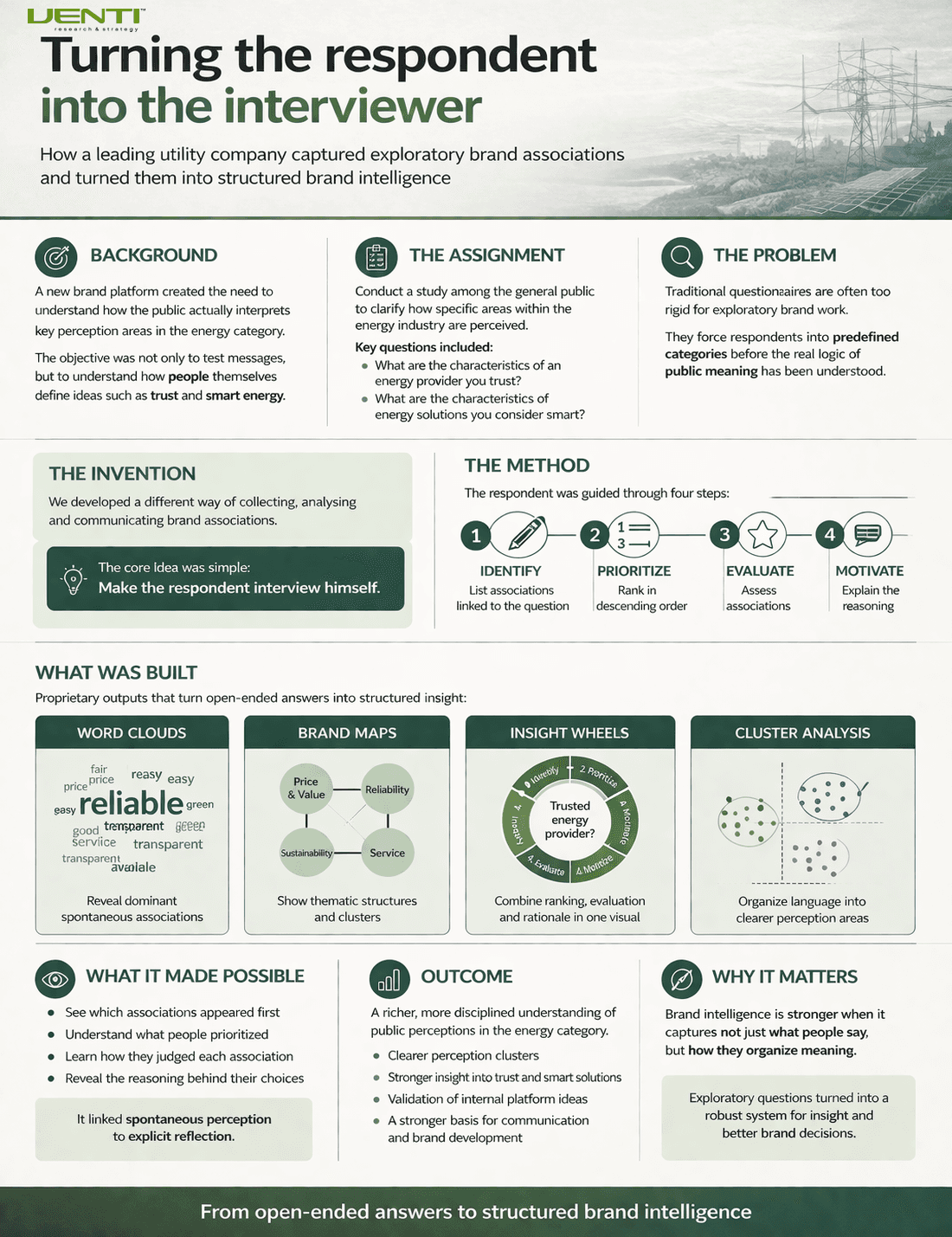
Turning the respondent into the interviewer
A new brand platform created a need to understand how the public actually interprets key perception areas in the energy category. The objective was not only to test messages, but to understand how people themselves define ideas such as trust and smart energy.
Background
The objective was not only to test messages, but to understand how people themselves define ideas such as trust and smart energy.
The assignment
Conduct a study among the general public to clarify how specific areas within the energy industry are perceived.
- What are the characteristics of an energy provider you trust?
- What are the characteristics of energy solutions you consider smart?
The problem
Traditional questionnaires are often too rigid for exploratory brand work. They force respondents into predefined categories before the real logic of public meaning has been understood.
The invention
We developed a different way of collecting, analysing and communicating brand associations. The core idea was simple: make the respondent interview himself.
The method
The respondent was guided through four steps:
- Identify: List the associations linked to the question
- Prioritize: Rank the associations in descending order
- Evaluate: Assess the associations
- Motivate: Explain the reasoning behind the evaluation
What was built
The work combined a set of proprietary outputs that made open-ended answers operational:
- Word clouds
- Brand maps
- Insight Wheels
- Cluster analysis
What it made possible
The method made it possible to see:
- which associations appeared first
- which ones people considered most important
- how they judged them
- why they reasoned the way they did
- It linked spontaneous perception to explicit reflection
Outcome
The result was a richer and more disciplined view of how the public understands trust, smart solutions and related perception areas in the energy category.
- clearer perception clusters
- stronger insight into public meaning
- a better test of whether internal platform ideas were anchored externally
- a more usable basis for communication and brand development
Why it matters
Brand intelligence becomes stronger when it captures not only what people say, but how they organize meaning for themselves. This case turned exploratory brand questions into a more robust system for collecting, analysing and communicating public perception.