
Risk management
Defining reputation risk beyond Basel III
A large financial institution faced a practical problem: Basel III offered limited guidance on reputation risk, even though transparency in measuring and managing the risk was increasingly expected.
The context
That created a need for a clearer internal framework for how reputation risk should be defined, measured, managed and communicated.
The objective
The aim was to turn reputation risk into something more operational. The work needed to establish:
- a usable definition of the risk
- a measurement logic linked to business impact
- a management process
- a communication framework that could support governance and reporting
The approach
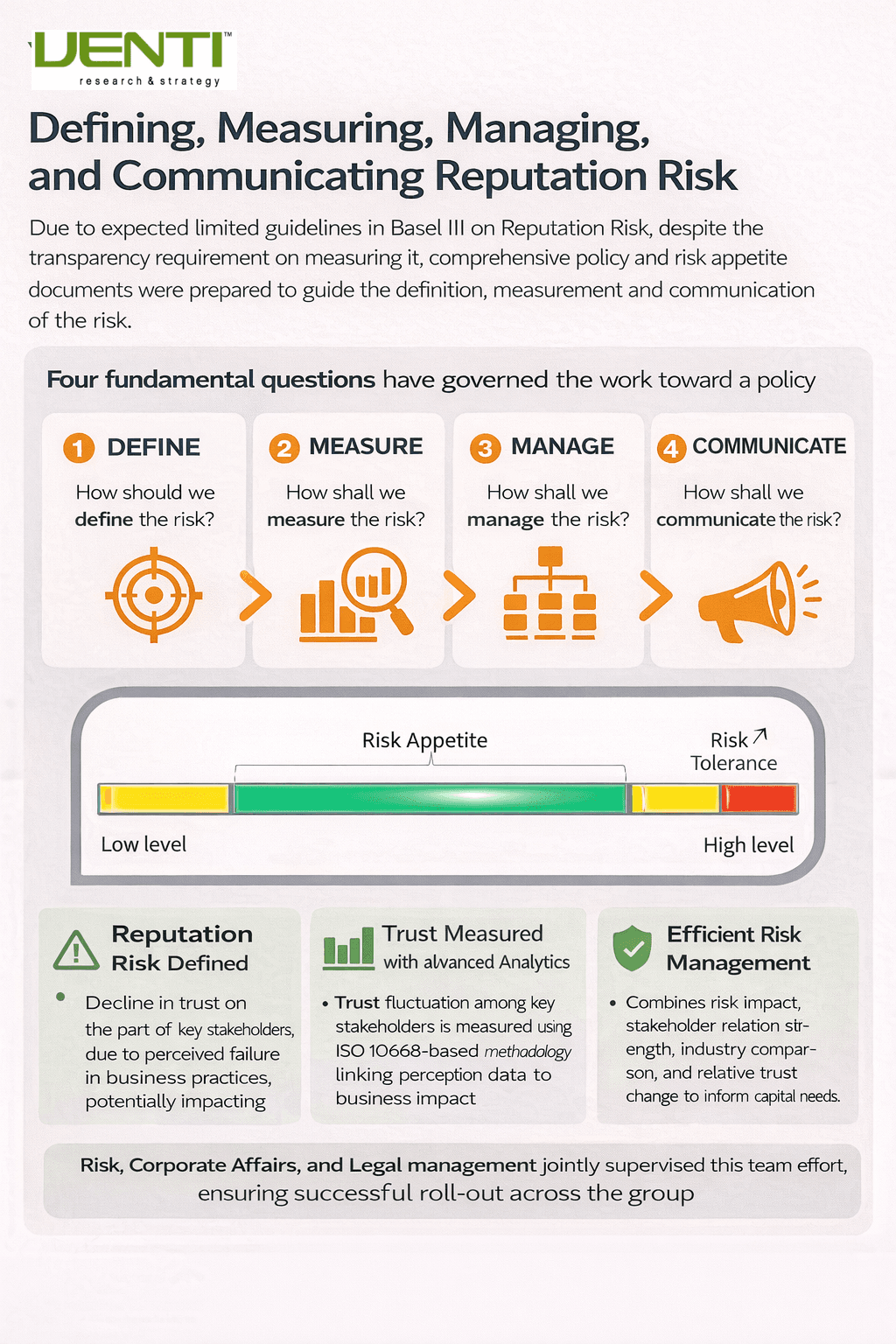
The work was structured around four core questions:
- How should the risk be defined?
- How should it be measured?
- How should it be managed?
- How should it be communicated?
- Two documents were prepared for approval: a policy document and a risk appetite document
- The process was supervised jointly by Risk, Corporate Affairs and Legal to ensure that the framework was robust and workable across the organization
What was built
Reputation risk was defined as a decline in trust among key stakeholders caused by perceived failure in business practices, with potential impact on earnings and both tangible and intangible assets.
- a quarterly measurement model using methodology that links perception data to business impact in line with ISO 10668
- the ability to combine risk impact with stakeholder relevance
- comparison of trust levels against industry benchmarks
- tracking of relative movement over time
- an indication of whether additional capital might be needed as a safeguard against trust deterioration
Outcome
The result was a clearer and more disciplined reputation risk framework. What had previously been a vague and difficult-to-govern issue became a structured management topic with clearer definitions, reporting logic and decision support.
Why it matters
Reputation risk becomes meaningful when it moves beyond general concern and becomes measurable, governable and linked to financial consequence. This case shows how a broad reputational issue can be translated into a practical policy, a measurable risk logic and a more credible basis for management action.