
Segmentation
Identifying food customer archetypes
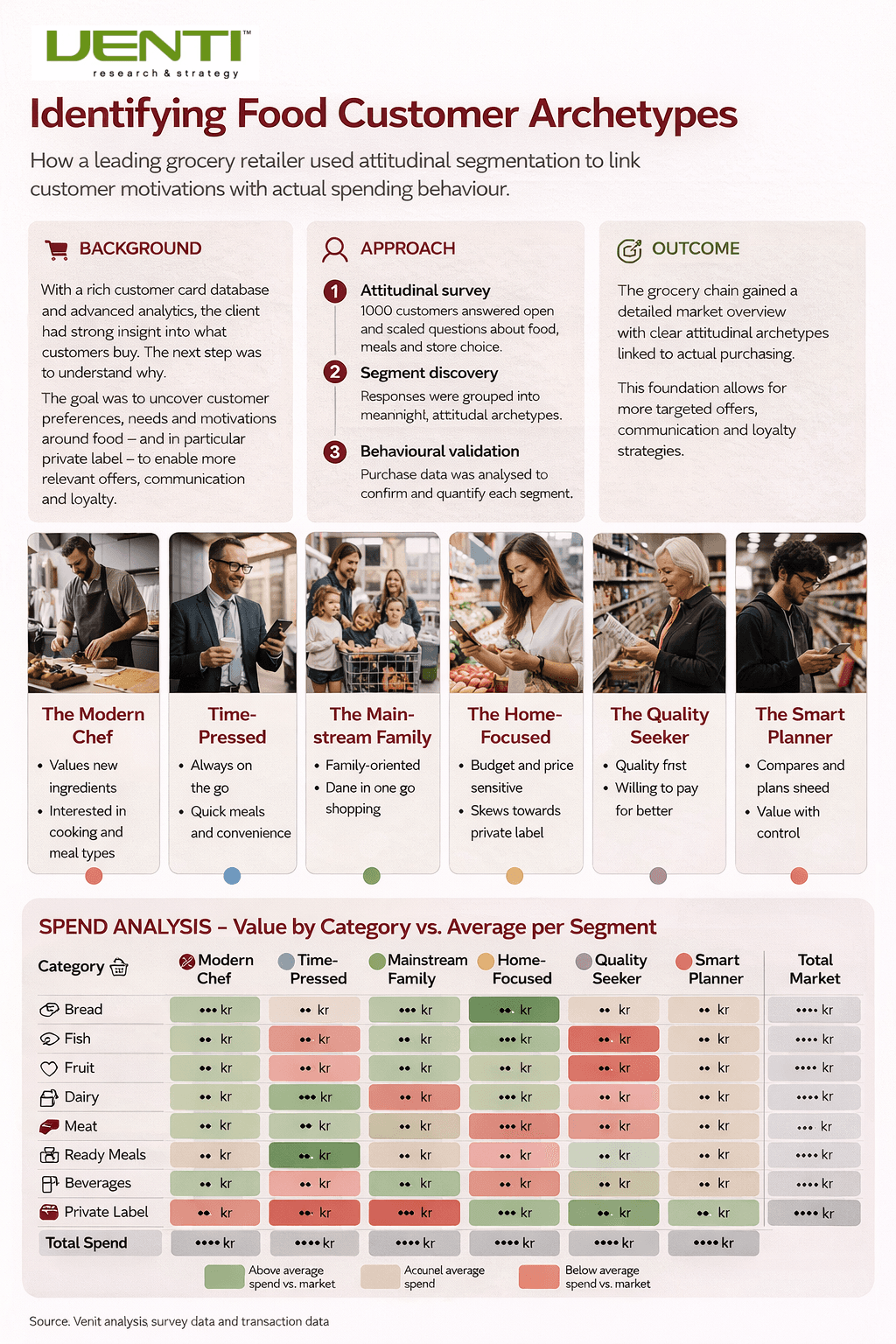
A leading grocery retailer already had strong transaction data and a clear view of what customers bought. The next step was to understand why different customers shop the way they do: their preferences, needs, attitudes and motivations around food, meals and private label.
The objective
The goal was to identify meaningful customer archetypes in the market and turn them into a more practical basis for communication, offers and channel choice. The ambition was to connect attitudes to real buying behaviour, so the business could act on more than demographics alone.
The approach
The work combined attitudinal segmentation with behavioural validation.
How it was done
A national customer survey was used to map attitudes to food, meals and store choice. Customers were then grouped into distinct need-based profiles. These profiles were tested against actual purchase behaviour in order to verify that the segments were not only attitudinally different, but commercially relevant.
What was built
The result was a segmentation framework built around identifiable food customer archetypes, each with its own motivations, shopping logic and category bias.
- customer attitudes
- store choice drivers
- food-related motivations
- observed spending patterns across categories
Outcome
The retailer gained a clearer view of which customer types existed in the market, how they differed, and how those differences showed up in actual baskets and category spend.
- more relevant offers
- sharper communication
- better channel choices
- more customer-specific commercial activation
Why it matters
Customer segmentation becomes more useful when it moves beyond description and starts guiding action. This case showed how attitudinal differences could be translated into practical commercial choices by linking mindset to real spending behaviour.