
Method
How to build a brand index that holds scrutiny
Brand measurement is entering a new phase.
Legacy models — from 80s brand pyramids to 00s ranking tables — were not built for remuneration, valuation or capital allocation.
They described brands; they didn’t operationalize them.
The unanswered question has always been the same:
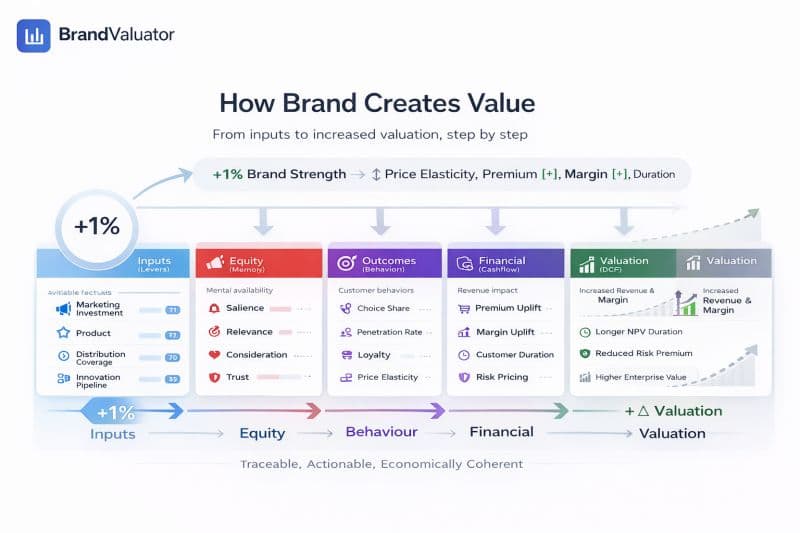
What does +1% brand strength actually do to the P&L and the DCF?
Without an answer, brands remain symbolic.
With an answer, they become economic.
ISO 20671 marks the shift.
Brands must now be evaluated through attributes, indicators and causality rather than narrative frameworks.
The emerging architecture is straightforward:
Inputs → Equity → Market Outcomes → Financial Contribution
Each layer decomposes into drivers that can be influenced and effects that can be priced:
Inputs: quality, distribution, innovation, codes
Equity: salience, trust, relevance, distinctiveness
Outcomes: loyalty, penetration, elasticity, stability
Financial: premium, margin, volatility, duration
This structure enables the core calculation legacy models could not:
connecting improvements in brand strength to changes in choice, elasticity, margin and cashflow.
That is the real “why bother.”
If +1% brand strength translates into
higher pricing power,
lower churn,
more stable cashflows,
and longer duration —
then brand becomes a capital asset, not a communications artefact.
In the coming months, the full index will be released publicly — module by module — and it will be free and open.
The field benefits from transparency, comparability and shared standards, not black boxes.
If brand performance is to matter at board level, it must be measurable, auditable and financially consequential.
That is what the next generation of brand indices aims to deliver.