
Decision Logic
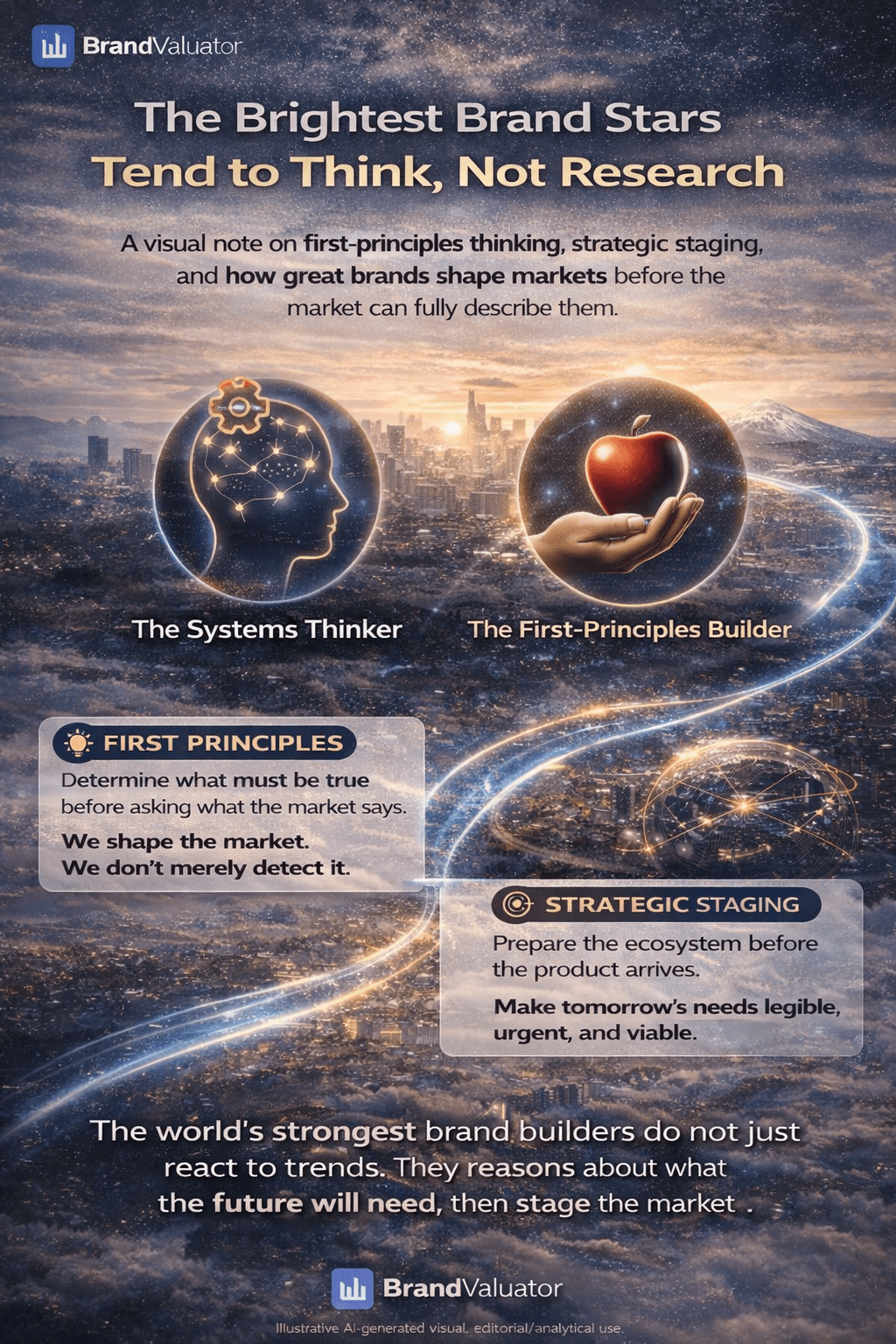
The brightest brand stars tend to think, not research
Listening to Jensen Huang made me re-articulate a law of product development: at the highest level, the decisive advantage is not always better measurement of existing demand. It is better reasoning about what must be true.
There is an old Kotler line, if the story is true: “I cannot write the perfect standard marketing book. It’s not that I don’t understand how and what it should be about. The problem is: what should I sell the day after I release it?” The point is not ignorance. The point is timing.
Nvidia, according to Jensen, seems to reason from first principles in much the same way. What do people actually need in order for AI to become useful? And just as important: when should that need be realized?
When Lex Fridman asked how they decide what to prioritize, Jensen’s answer was strikingly simple: “We have a discussion.” “We don’t need any fancy research.” “We just think.”
That is a remarkable statement. It suggests that the frontier of product creation is often cognitive before it is procedural. The hard problem is not only detecting demand. It is reasoning toward what will matter, and then preparing the market for it.
Jensen describes this explicitly. If Nvidia wants to build something new, such as agentic AI, the ecosystem must be prepared years in advance. People almost need to feel that the company is late, otherwise the internal and external buy-in does not fully form.
That is not classical market-research logic. It is strategic staging. You do not merely respond to demand. You shape the conditions under which demand becomes legible, urgent, and commercially viable.
Musk works in a similar first-principles way. The reasoning appears to happen inside the company, not primarily in a research department. Research may still have a role, but it looks secondary and bounded.
The deeper point is that the brightest brand stars do not just ask people what they want. They try to understand what is necessary, what is possible, what will matter, and what the world will eventually organize around.
They do not outsource judgment.
They do not confuse data collection with vision.
They think.