
Method
Decision-tree analysis used to be standard craft
So what happened?
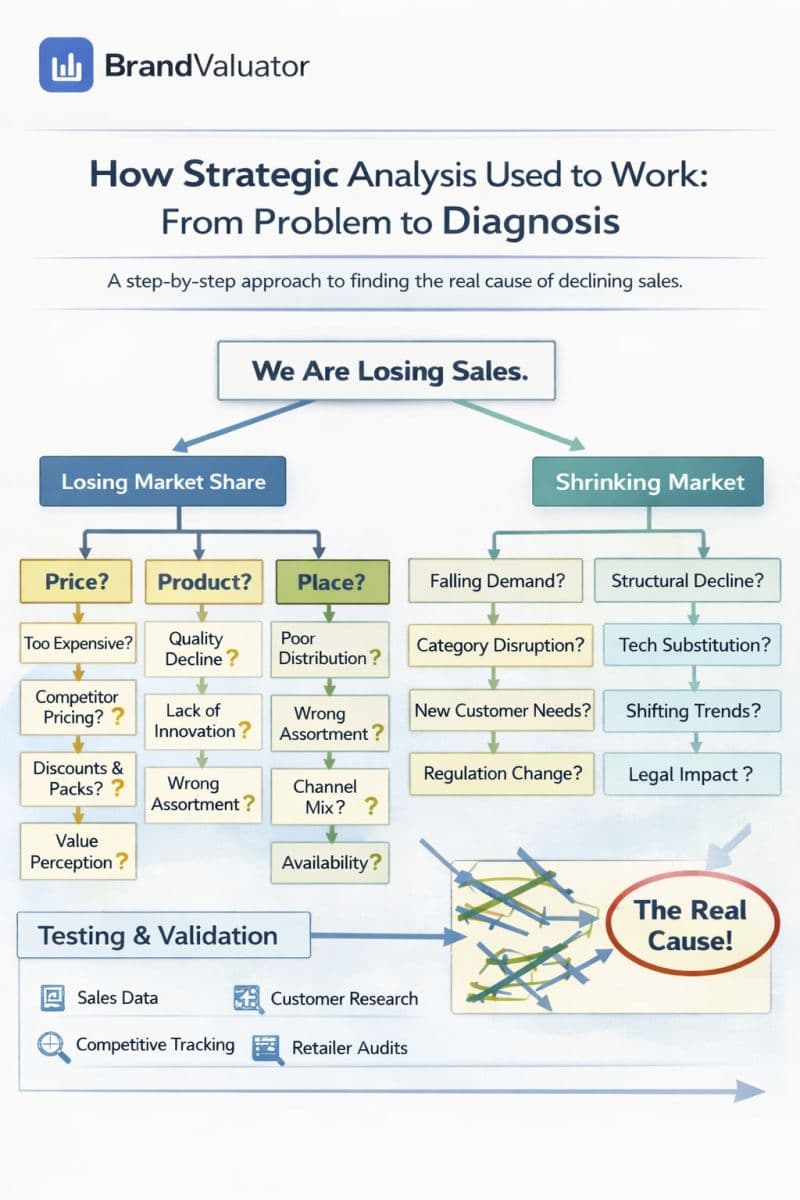
Decision-tree analysis used to be standard craft. And not just among your average McKinsey consultant. Anyone with proper commercial training understood the logic.
You started with a business problem that could be framed in simple commercial terms. Very often, the top node was something like:
We are losing sales.
From there, the first split was obvious:
1. We are losing market share
2. The total market is shrinking
That distinction mattered, because it forced you to separate a company-specific problem from a market-wide problem. If the whole market was down, that was one kind of strategic issue. If the market was stable or growing, but your sales were falling, then the problem was internal or competitive.
If the issue was loss of market share, the next step was to break it down into the classic drivers:
Price
Product
Place
Promotion
Each of those branches was then dissected further.
If it was price, you asked:
Are we too expensive versus competitors?
Have competitors changed their pricing model?
Are discounts, pack sizes, or price architecture hurting us?
Has perceived value dropped relative to price?
If it was product, you asked:
Has quality declined?
Is the assortment wrong?
Are we lagging in innovation?
Does the product still solve the customer’s problem better than alternatives?
If it was place, you looked at:
Distribution coverage
Shelf visibility
Channel mix
Availability
Whether customers could actually find and buy the product
If it was promotion, you examined:
Awareness
Message clarity
Media weight
Creative effectiveness
Whether the brand was still salient and persuasive in the buying moment
And if the issue instead came from the shrinking market branch, you asked a different set of questions:
Is demand structurally falling?
Is the category being disrupted?
Are customer needs changing?
Is regulation, technology, or substitution reducing the market?
The point was not to sound clever. The point was to turn a messy commercial problem into a structured set of hypotheses.
At the end of every branch, you put a question mark.
That question mark mattered. It meant: this is a hypothesis, not yet a conclusion.
Then you went out and tested the tree:
with sales data
retailer feedback
customer interviews
price tracking
market shares
brand tracking
distribution audits
And then, three months later, you could literally cross out some branches and circle the one that actually explained the problem.
That was the discipline.
It forced people to think causally. To separate symptoms from drivers. To distinguish what was knowable from what was guesswork.
Somewhere along the way, a lot of that discipline got replaced by adjectives, dashboards, and fashionable language.
But the old logic was powerful:
Start with the commercial problem. Split it into mutually exclusive explanations. Test them one by one. Then identify the real cause.
That is not outdated.
That is still how serious analysis should be done.