
Perception
Expensive shampoo
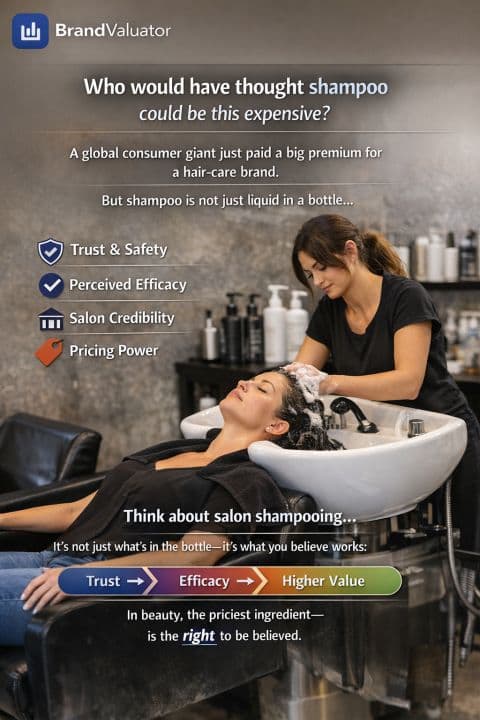
Who would have thought shampoo could be this expensive?
Honestly: why does anyone spend SEK 500 on shampoo?
Yet Henkel just paid roughly a 50% premium to buy Olaplex. And this is not some random buyer. Henkel owns brands like Schwarzkopf and Persil. In other words: people who understand chemistry, packaging, distribution, and branding at scale still decided this hair-care brand was worth paying up for.
So what is Olaplex, really?
At one level, it is hair care: shampoo, conditioner, treatments, styling products. At another, it is a trust system wrapped around a beauty promise: repair, protection, salon credibility, and the feeling that this is not generic liquid in a bottle.
Because what is shampoo, technically?
Mostly water, surfactants, conditioning agents, preservatives, fragrance, thickeners, and a few active ingredients. In plain English: the formula is often not where most of the value sits.
So why did Henkel pay up?
Because in categories like hair care, customers are not just buying chemistry. They are buying reduced risk.
Will this damage my hair?
Will it help colored hair?
Will it feel salon-quality?
Will I regret choosing the cheaper option?
That is where brand enters the economics.
A strong brand reduces perceived risk, simplifies choice, supports premium pricing, carries reputation across channels, and makes similar products feel economically different.
That is the deeper point in the Olaplex acquisition.
The more similar products become in the factory, the more valuable it becomes to be non-interchangeable in the customer’s mind.
So yes, shampoo may look overpriced if you only analyze the bottle.
But if you analyze trust, perceived efficacy, salon aura, and pricing power, Henkel’s premium starts to make more sense.
The uncomfortable conclusion?
In categories like this, the expensive thing is often not the formula.
It is the right to be believed.