
Brand Value
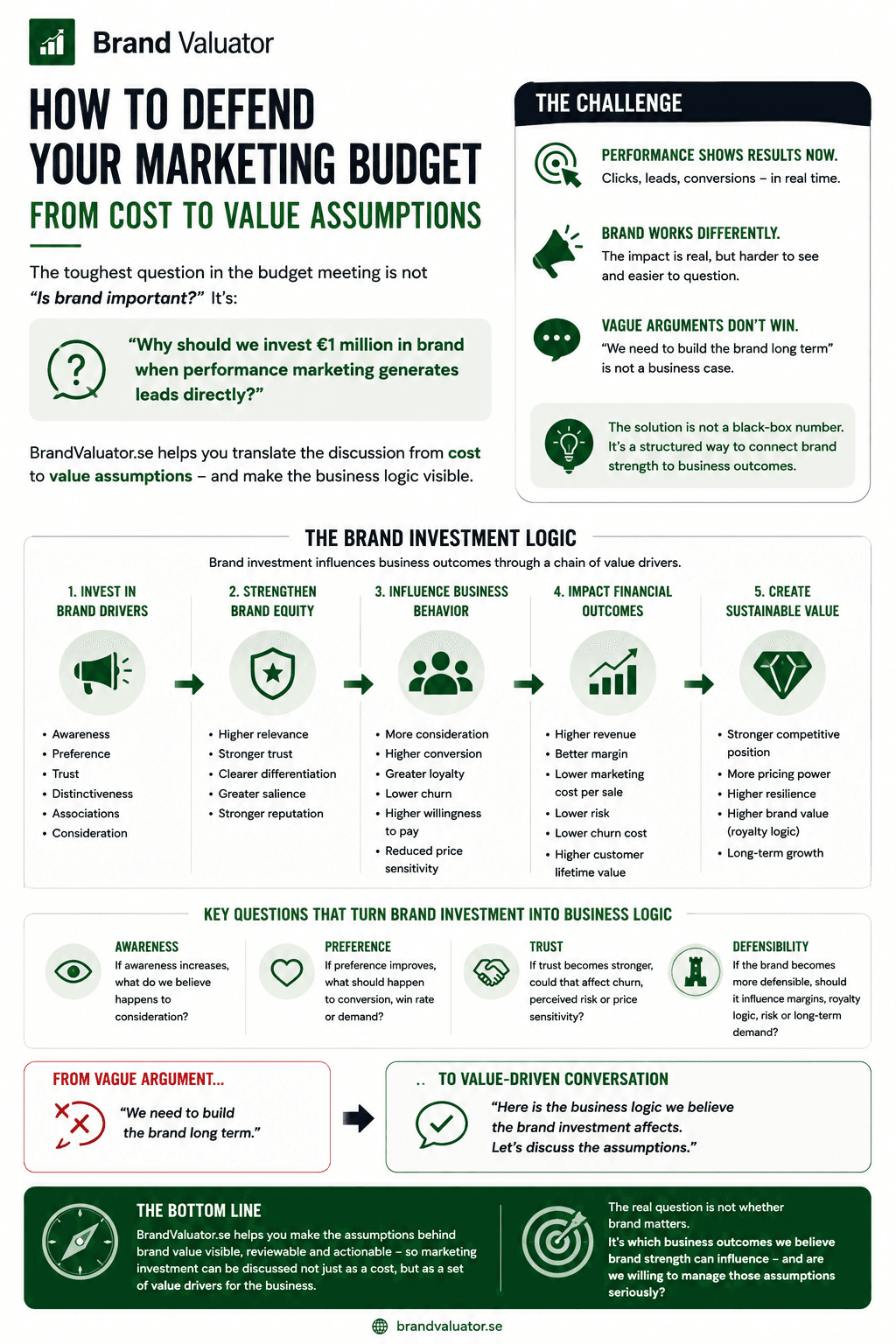
How to defend your marketing budget
One of the hardest conversations in marketing is not whether brand matters.
Most people agree that it does.
The harder conversation starts when brand investment competes with activities that show faster and more measurable results.
Performance marketing can point to clicks, leads and conversions.
Sales can point to pipeline.
Finance can point to cost, margin and payback.
Brand works differently.
It influences whether people know you, trust you, prefer you, stay with you, pay more for you — or choose you when alternatives look similar.
But if that logic is not made explicit, brand investment can easily become either a belief system or a defensive argument.
There is a better way to have the conversation.
Not by pretending that brand value can be measured with perfect precision.
And not by reducing marketing to short-term ROI.
But by making the assumptions behind brand investment more visible.
If awareness improves, what should happen next?
If preference strengthens, where should that show up commercially?
If trust increases, could it affect churn, risk, conversion or price sensitivity?
These are better questions than simply saying:
“We need to build the brand long term.”
That may be true.
But it is rarely enough.
The future of brand measurement is not just more dashboards, tracking data or valuation numbers.
It is better bridges between brand strength and business decisions.
Where does the link between brand investment and business value most often break down?