
Valuation
The kitchen table is the real competitor
So are you like me?
Do you buy sports nutrition, gels, drink mixes, or carbohydrate powders when you do your long runs?
You probably think:
I need carbs to do long runs.
And you are right.
Sports science has shown that endurance athletes can train the gut to absorb very high amounts of carbohydrate per hour. In some cases, up towards 90–120 grams per hour, and in more extreme protocols even higher.
In simple energy terms, 200 grams of carbohydrate is roughly 800 kcal.
That is a lot of fuel.
But this is where it becomes interesting from a brand economics perspective.
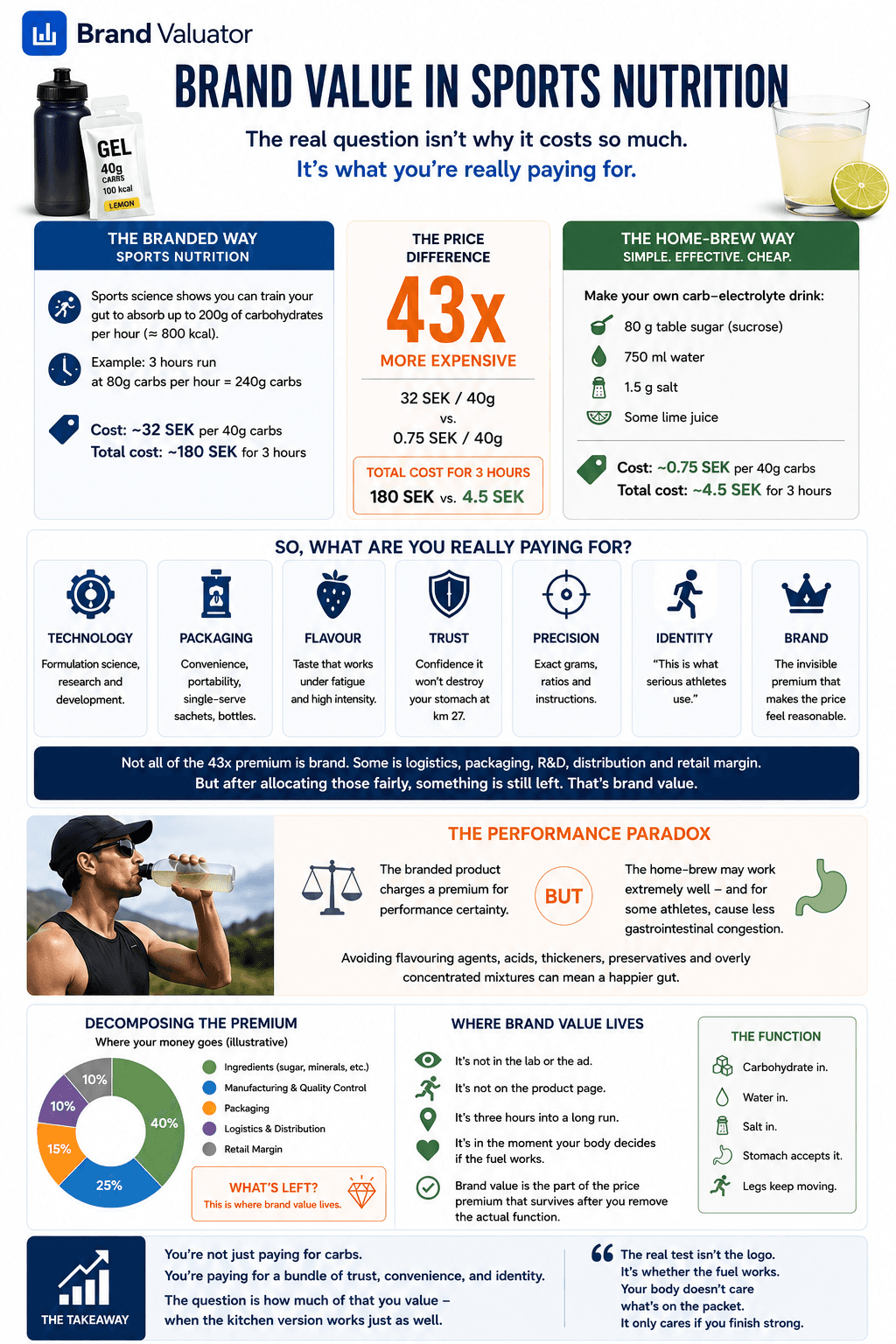
A branded sports nutrition product may cost around 32 SEK per 40 grams of carbohydrate. If you run for three hours and consume 80 grams per hour, that is 240 grams of carbohydrate.
In total, that can easily end up around 180 SEK for one long run.
Now compare that to the home-brew version:
80 g table sugar
750 ml water
1.5 g salt
some lime juice
Shake it properly, let it dissolve, and you have a functional carbohydrate-electrolyte drink.
Nutritionally, you are surprisingly close.
In fact, table sugar is not some primitive fuel. It is sucrose — glucose and fructose — which is exactly the kind of dual-carbohydrate logic many modern sports drinks are built around.
The price?
Roughly 0.75 SEK per 40 grams of carbohydrate.
So the branded product is not 10 percent more expensive.
It is not 50 percent more expensive.
It is not even twice the price.
It may be around 40x more expensive.
That is the interesting part.
Sports nutrition brands have done a marvellous job of defending the premium. But not mainly against other sports nutrition brands.
The real competitive threat is not Maurten versus SIS versus Neversecond versus Precision Fuel.
The real threat is the kitchen table.
Sugar.
Salt.
Water.
Lime.
That is the category’s uncomfortable truth.
So what are you really paying for?
Not just carbohydrates.
You are paying for:
Technology — or at least the belief that the formulation is more advanced.
Packaging — portability, convenience, sachets, bottles, gels.
Flavour — something that tastes controlled under fatigue.
Trust — the feeling that this will not destroy your stomach at kilometre 27.
Precision — exact grams, exact ratios, exact instructions.
Identity — this is what serious endurance athletes use.
Brand — the invisible premium that makes the price feel reasonable.
Of course, the whole 40x premium is not “brand value”. That would be too simplistic.
Some of the premium is logistics.
Some is packaging.
Some is product development.
Some is distribution.
Some is retailer margin.
Some is convenience.
But after decomposing the components and pricing them wisely, there is still something left.
And that leftover is where brand value lives.
The most interesting part is this:
The home-brew may work extremely well. It may even create less gastrointestinal congestion for some athletes, because it avoids flavouring agents, acids, thickeners, preservatives, or overly concentrated mixtures.
The stomach may not be reacting to the sugar and water.
It may be reacting to everything else around it.
So the paradox becomes sharp:
The branded product charges a premium for performance certainty.
But the cheap home-brew may deliver the same functional outcome — sometimes even better.
That is a beautiful brand valuation problem.
Because brand value is not simply the price premium.
Brand value is the part of the price premium that survives after you have removed the value of the actual function.
And in sports nutrition, the function may be brutally simple:
Carbohydrate in.
Water in.
Salt in.
Stomach accepts it.
Legs keep moving.
Everything above that is economics, psychology, and branding.
So the real question is not:
Why does sports nutrition cost so much?
The real question is:
How much of the premium remains when the athlete realises that the kitchen version works?
That is where brand value is tested.
Not in the ad.
Not in the lab.
Not in the product page.
But three hours into a long run, when the body does not care about the logo.
It only cares whether the fuel works.